

Jublet is a roommate matching app for Bangalore, built by Himalya NextGen. It helps students and working professionals find a compatible roommate or PG before they worry about rent. This case study explains the problem, the product decisions, how the app was built and what we would tell anyone planning a similar marketplace.
Quick facts: Flutter mobile app for Android, a marketing website, phone OTP sign-in, lifestyle matching, mutual-interest chat and PG or shared-room listings. Launch city: Bangalore. Live at jublet.com and on Google Play. See the full project page: Jublet roommate app.
The problem: finding a room is easy, finding the right roommate is not
In Bangalore, most people look for a room through broker listings, social media groups and WhatsApp forwards. The common complaints were consistent:
- Brokers charge fees and show rooms, not people.
- Groups are full of spam, duplicate posts and stale listings.
- There is no way to filter on how someone actually lives: food habits, smoking, work shifts, guests, cleanliness.
- Sharing your phone number publicly invites unwanted calls.
A mismatch on small habits is what makes a shared flat miserable. Rent matters, but lifestyle decides whether you stay.
The product idea
Jublet puts people first and rooms second. Instead of browsing flats, you browse profiles of people and listings that match your lifestyle. The core product decisions were:
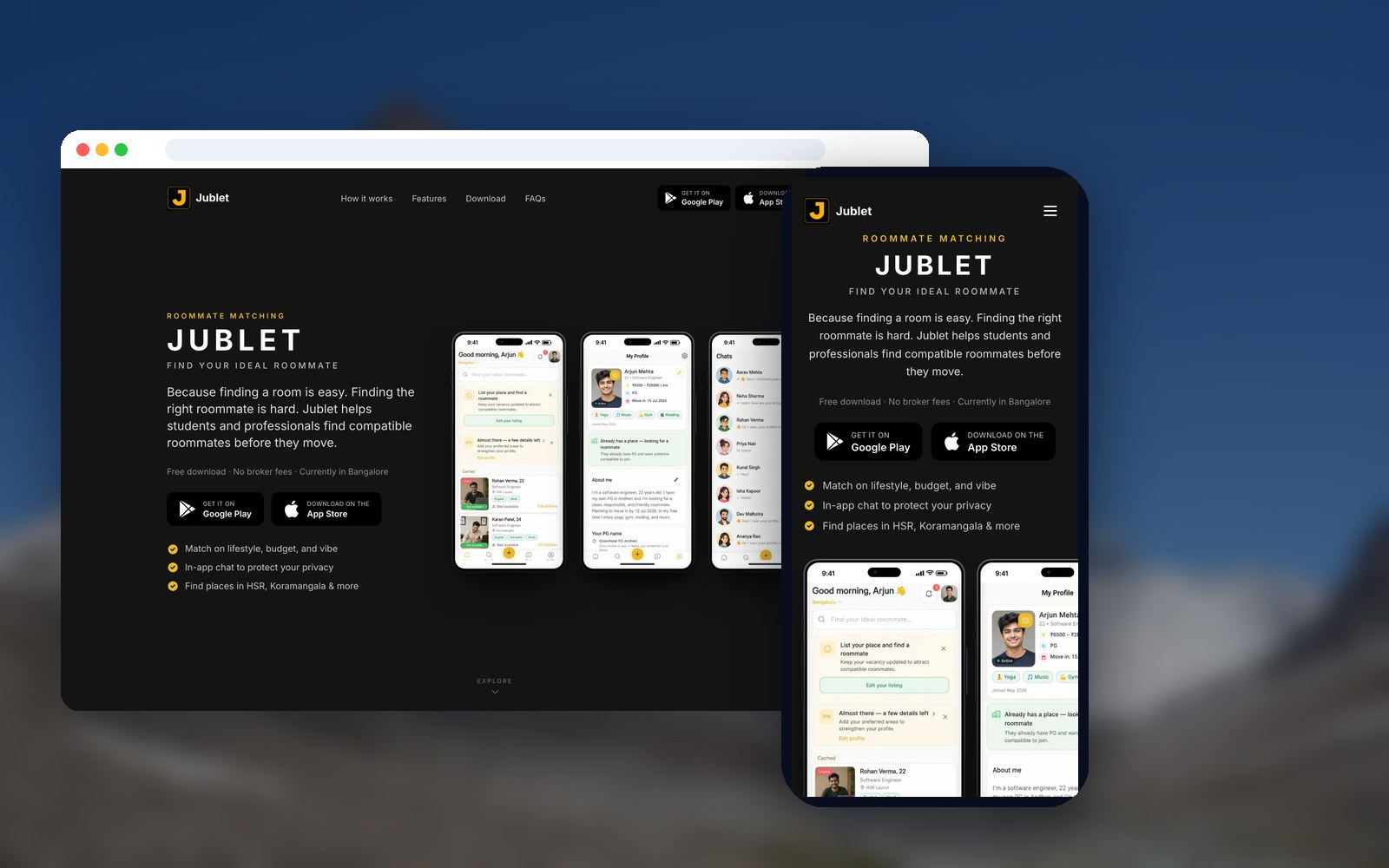
- Lifestyle compatibility. Matching on food, smoking, drinking, pets, guests, shift timings, cleanliness, hobbies and languages, not only budget.
- Mutual interest before chat. Messages open only when both people tap interested. This removes cold messages and harassment.
- Private phone numbers. Users sign in with a phone OTP, but their number is not shown to others.
- References after matching. Instead of anonymous star ratings, people can leave references once they have actually matched.
- Zero broker fees. The product is free for students and professionals to use.
- Neighbourhood-first discovery. A feed organised by Bangalore areas, since nobody wants a two-hour commute.
What we built
| Part | What it does |
|---|---|
| Flutter mobile app | Onboarding, lifestyle profile, discovery feed, mutual interest, in-app chat with read receipts, listings |
| Listings for hosts | PG, shared room and replacement-roommate listings with amenities, photos, urgency flags and a pause option |
| Authentication | Phone OTP verification through Firebase |
| Notifications | Firebase Cloud Messaging for matches and messages |
| Backend and admin tooling | Node.js API and web tooling to manage users and listings |
| Marketing website | A Next.js landing site that explains the product and links to Google Play |
The app uses Flutter and Dart with BLoC for state management, Dio for networking and Hive for local storage, so the app opens quickly and keeps working on weak connections. The same codebase can later extend to iOS.
How we worked
Step 1: Product discovery
We mapped real pain points, including WhatsApp spam, broker fees and the lack of lifestyle filters, into a people-first brief. The most useful question we asked was "what makes someone leave a flat?", because the answers shaped the matching fields.
Step 2: App and backend build
We shipped the Flutter app with OTP sign-in, the discovery feed, mutual interest, chat, listings and push notifications in focused stages, so the founders could test each flow on real phones.
Step 3: Launch
We published the Android app on Google Play, launched the marketing site and set up the pieces needed for store review, such as a privacy policy and clear data handling. That store work is a common stumbling block for first-time founders. See our app store and Google Play launch checklist.
Design choices that mattered
- Safety by default. Mutual-only chat and hidden phone numbers were not extras. They were the reason people would trust the app.
- Few, meaningful questions. Long forms kill onboarding. We kept the profile focused on the habits that actually cause conflict.
- Listings that can pause. Hosts are not always searching. A pause option stops them being pestered after they find someone.
- Local first. Launching in one city kept the supply of people and rooms dense enough to feel useful.
Lessons for anyone building a marketplace or matching app
- Solve the cold-start problem on purpose. A matching app is empty without people. Pick one city or community and concentrate there.
- Design trust before features. Verification, privacy and blocking tools are core product, not polish.
- Build the smallest version that can be tested. Our MVP guide explains how to cut scope without cutting quality.
- Plan for upkeep. A live app needs updates for new OS versions and ongoing moderation. See what it costs to maintain an app.
FAQ
Who built the Jublet app?
Himalya NextGen, a software company in Dehradun, designed and built the Jublet product, including the Flutter app, backend, admin tooling and marketing website.
What technology does Jublet use?
Flutter and Dart for the app, Firebase for authentication and push notifications, a Node.js API, and a Next.js marketing site.
How is Jublet different from broker apps?
Jublet is roommate-specific. You browse people first, match on lifestyle, express mutual interest, then chat, with no broker fees.
Is Jublet only for Bangalore?
The launch is focused on Bangalore neighbourhoods, with other cities possible later.
How much would a similar app cost?
A matching and listings app with chat and notifications is usually a mid-sized build. Read how much it costs to build a mobile app in India for ranges, then request a free estimate.
Want to build a marketplace, matching or community app? Talk to the team that built Jublet. Get a free quote or browse more projects.
Topics: jublet · jublet app · roommate app case study · flutter marketplace app
Keep reading
Case Studies · 4 min read
Spottix Case Study: Building a GPS Civic Reporting App
How we built Spottix, a GPS civic reporting platform with Flutter apps, PostGIS, background workers and an authority admin panel.
Design · 5 min read
Brand System Maintenance Budget: What to Fund After Launch
What to budget after a brand system launches: eight recurring tasks, sample yearly budgets by company size and a 90-day plan.