
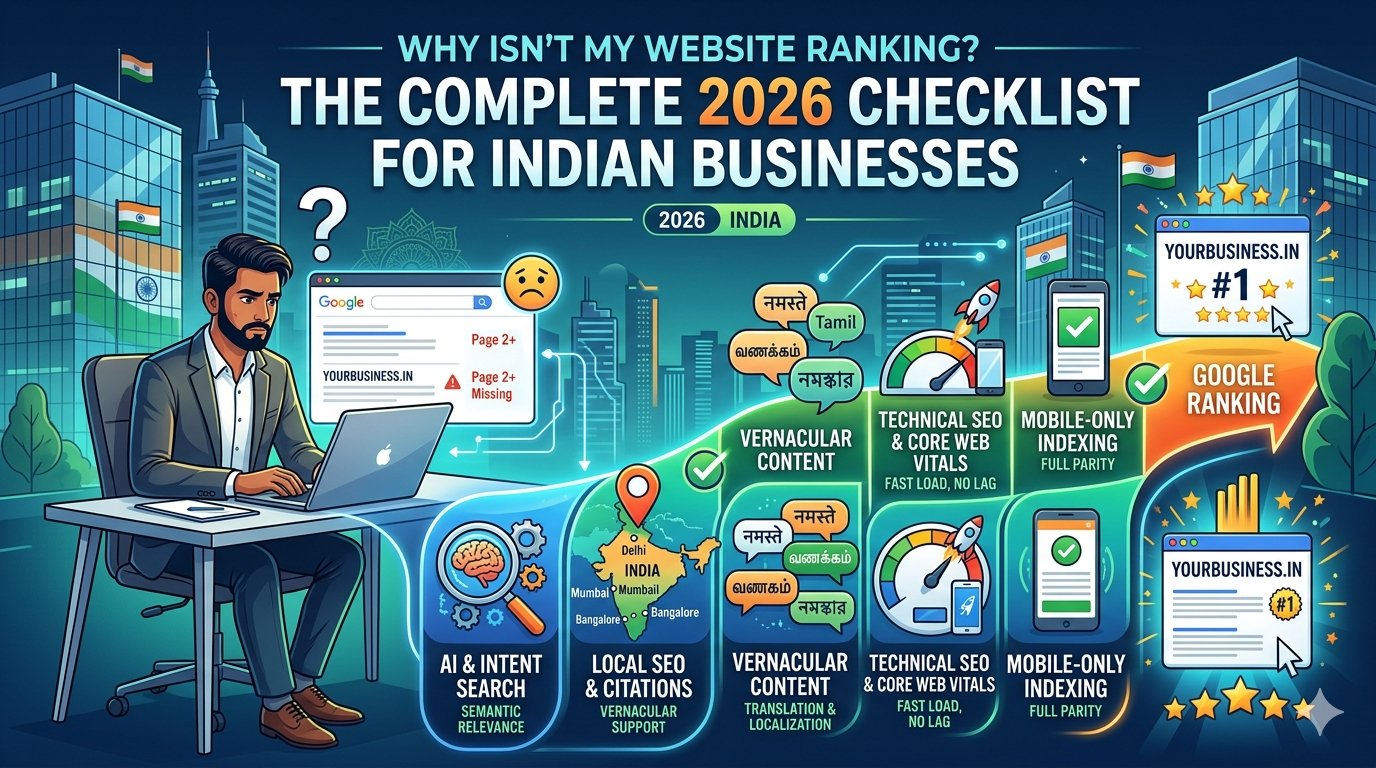
The Expensive Silence After Launch Day
You spent money building a website. A developer delivered it, you went live, and you waited. Nothing happened. No calls, no inquiries, no orders — just silence, and a growing suspicion that the entire investment was wasted. This is one of the most common and most damaging experiences businesses have with the web in 2026, and it has a specific, completely diagnosable cause. Websites do not rank on Google by accident. They rank because of a precise set of technical, content, and authority signals that Google measures continuously against every competing page on the internet. When a significant number of those signals are missing or broken, the site simply does not appear — not on page one, not on page five, sometimes not in any meaningful position at all.
The frustrating reality is that most businesses discover this problem months after launch, after the developer has moved on and the initial marketing budget has been spent elsewhere, while competitors who built their sites correctly have already claimed the rankings you needed. The good news is that every single problem on this list is measurable, fixable, and directly connected to a specific Google ranking signal. If your website is not bringing in traffic, the answer is almost certainly somewhere in what follows.
How Google Actually Decides Who Reaches Page One
Google's ranking algorithm processes over 200 individual signals when deciding which pages appear for any given search query. For practical purposes, those signals fall into three categories every business owner must understand. The first is technical health — everything that determines whether Google can find, crawl, understand, and index your pages correctly. The second is content quality — whether your pages contain substantive, accurate, well-organised information that genuinely matches what the searcher was looking for. The third is authority — whether other credible websites link to yours, signalling that your content is trustworthy and worth surfacing to others.
Most Indian business websites fail primarily on technical health. Not because their developers were careless, but because outdated tech stacks, cheap shared hosting, template-based CMS platforms, and neglected maintenance accumulate technical debt faster than it is addressed. A site that passes basic technical checks at launch can develop critical ranking-suppressing issues within six months through nothing more than plugin updates, database growth, and server degradation — with no visible warning to the business owner, and no obvious symptoms beyond a rankings plateau that never improves.
Problem One — Your Website Is Too Slow for Google to Recommend It
Page speed is one of the most heavily weighted technical ranking signals in Google's algorithm, and it is the problem most Indian business websites fail most severely. Google's own data shows that as page load time increases from one second to three seconds, the probability of a mobile visitor leaving before the page finishes loading increases by 32%. At five seconds, that probability reaches 90%. For most shared-hosting WordPress sites in India, average mobile load times fall between four and eight seconds. That means the majority of visitors Google might send you are leaving before they ever see what your business offers.
The specific metrics Google measures are called Core Web Vitals. Largest Contentful Paint measures how long it takes for the main content of a page to become visible — Google wants this under 2.5 seconds. Cumulative Layout Shift measures how much the page jumps around while loading, which creates a disorienting experience on mobile — Google wants this below 0.1. Interaction to Next Paint measures how quickly your page responds when a visitor taps a button or a link — Google wants this under 200 milliseconds. These three scores are reported in Google Search Console for every indexed page, and pages that fail them are ranked lower than pages that pass them, even when the content quality is comparable. Checking your Core Web Vitals in Google Search Console right now costs nothing and tells you immediately whether this is suppressing your rankings.
Problem Two — Google Cannot Read Your Website Correctly
A website that looks beautiful to a human visitor can be nearly unreadable to Google's crawler, and the gap between those two experiences is where many ranking failures originate. Google does not see your website the way a person does. It reads the underlying HTML code, follows links between pages, and builds a structural map of your site's content and hierarchy. When that HTML is poorly structured — missing heading tags, lacking descriptive alt text on images, using JavaScript to render content that Google cannot execute, or presenting text as images rather than real text — Google cannot understand what the page is about, cannot categorise it correctly, and cannot surface it for relevant searches.
The most common structural issues on Indian business websites are missing or duplicated H1 tags, which are the primary signal Google uses to understand a page's main topic. Every page should have exactly one H1 tag that clearly states the page's subject. Missing meta descriptions do not directly suppress rankings, but they determine what appears in search results, and a blank or auto-generated meta description dramatically reduces click-through rates from the people who do see your listing. Images without alt text represent a complete missed opportunity for image search traffic and reduce Google's ability to contextualise the page. If your site was built by a developer who prioritised visual appearance over semantic HTML structure, these issues are almost certainly present throughout your site.
Problem Three — Your Site Is Not Set Up for Mobile-First Indexing
Since 2023, Google has operated entirely on mobile-first indexing — meaning it uses the mobile version of your website as the primary version it indexes and ranks, not the desktop version. If your mobile experience is poor, your rankings suffer everywhere, including on desktop searches. This is not a future consideration or a best practice recommendation. It is the current reality of how Google works, and sites that were designed primarily for desktop viewing and then adapted for mobile as an afterthought pay a significant ranking penalty for it.
A mobile-first website is not simply a website that shrinks to fit a phone screen. It is a website where every element — text size, button size, spacing, navigation, form fields, images, and interactive components — is designed to work naturally with a touch interface on a small screen. Text must be readable without zooming. Buttons and links must be large enough to tap accurately. Forms must not trigger the iOS zoom bug caused by input fields with font sizes below 16 pixels. Navigation must be accessible without a mouse hover. Pages must load fast on a 4G mobile connection, not just a fast office WiFi network. Google measures all of these signals and uses them to determine how prominently to feature your site in results across every device type.
Problem Four — You Have No Local SEO Signals
For Indian businesses serving customers in a specific city or region, local SEO is the single highest-return ranking investment available — and it is almost universally neglected by businesses whose developers focused on building the website and considered the job complete at launch. Local SEO is the set of signals that tells Google your business serves a specific geographic area, making you eligible to appear in the local map pack — the three business listings that appear at the top of Google results for searches like web development company in Dehradun or best restaurant near Connaught Place. Appearing in that map pack is worth more in qualified traffic than a page one organic ranking for most local businesses, because map pack results appear above organic results and include your phone number, address, and reviews directly in the search result.
The foundation of local SEO is a complete, verified, actively maintained Google Business Profile. This means a fully filled-out profile with accurate business name, address, and phone number — exactly matching what appears on your website. It means a business category that precisely describes what you do. It means a description that includes your primary service keywords and your city. It means photos updated regularly, which Google uses as a freshness signal. It means responding to every review, positive or negative, because review response activity is a ranking signal in the local algorithm. It means posting updates through Google Business Profile regularly. Most Indian businesses have either never claimed their Google Business Profile, or claimed it years ago and abandoned it — and this alone accounts for an enormous amount of missing local search visibility.
Problem Five — Your Content Does Not Match What People Actually Search For
The most technically perfect website in the world will not rank if its content does not match what real people actually type into Google when they are looking for what you offer. This mismatch between what businesses write on their websites and what their customers actually search for is one of the most common — and most invisible — ranking failures in existence. A hotel in Rishikesh that writes about its luxurious riverside sanctuary and spiritual ambiance on its homepage will not rank for budget hotel Rishikesh near Laxman Jhula — even though that is exactly what their potential customers search for — because those words do not appear on the page.
Keyword research is the process of finding the exact phrases real people use when searching for your products or services, and then building your content around those phrases rather than around the language your industry uses internally. Free tools like Google Search Console, Google Keyword Planner, and Google's own autocomplete suggestions show you exactly what people search for in your category. The highest-value keywords for local Indian businesses are almost always city-specific, service-specific, and problem-specific — phrases like affordable web developer in Noida, hospital management software India, or how to get FSSAI licence in Delhi. Pages built specifically around these phrases, with genuine and detailed content that answers the searcher's question, are the pages that rank.
The Fastest Path to Fixing All of This
Running through this checklist against your current website will reveal most of the reasons your site is not ranking. Google Search Console is free and shows you exactly which pages are indexed, which queries they appear for, which Core Web Vitals are failing, and whether Google has encountered any crawl errors. Google PageSpeed Insights gives you a detailed performance report for any URL in under thirty seconds. These two tools alone will give you a clear picture of your site's technical health at no cost.
The harder question is not diagnosis — it is repair. Fixing a slow WordPress site by patching plugins and compressing images is a temporary measure that requires ongoing maintenance and rarely achieves the performance scores that a site rebuilt on a modern framework achieves by default. Fixing poor HTML structure in a template-based CMS often means working around the template's limitations rather than solving the underlying problem. Fixing mobile experience issues in a site that was designed desktop-first often requires a rebuild rather than a rework.
At Himalya NextGen Technologies, we build every website on Next.js 16 with performance, mobile-first design, semantic HTML structure, and Core Web Vitals compliance built into the foundation — not added as afterthoughts. We serve our media through Cloudinary CDN for automatic image optimisation, use Redis caching to eliminate slow database queries, and host on Supabase infrastructure in Mumbai for the fastest possible response times for Indian visitors. Every project includes Google Search Console setup, schema markup implementation, and a local SEO foundation that puts your business in front of the people searching for exactly what you offer. If your website is currently invisible to Google, we would be happy to show you exactly why — and exactly what it would take to change that.
Continue Reading
Complete Guide to School ERP Software: Features, Benefits & Why Every School Needs It
If you're a school administrator, principal, or trustee tired of juggling spreadsheets, paper fee receipts, and disconnected systems, it's time to see what a proper school ERP system can do for your institution. Get in touch with Himalya NextGen today: 🌐 www.himalyanextgen.com Whether you're a school in Dehradun, Lucknow, Noida, Gurugram, Kolkata, or anywhere else in India — we'd love to help you build a smarter, simpler way to run your school.
Why Next.js Is the World's Most Trusted Web Framework in 2026 — And What Your Business Is Missing
Over 319,967 companies including Amazon, IBM, Nike, and McDonald's have standardised on Next.js. Discover why the world's most serious businesses made the switch — and what you risk by staying on outdated technology.