The Commission Problem Every Uttarakhand Property Owner Knows But Rarely Talks About
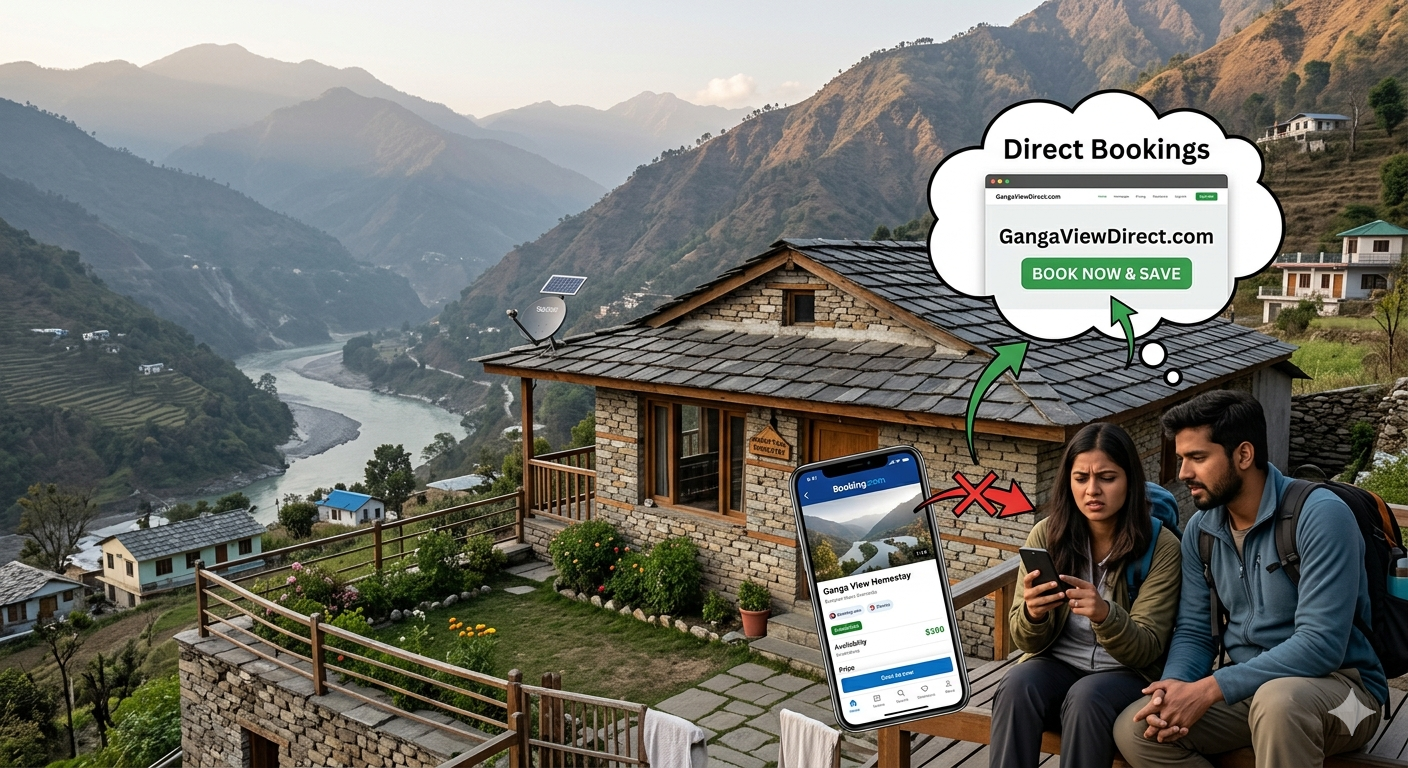
Uttarakhand welcomed over 38 million tourists in 2024, making it one of the most visited states in India. Rishikesh, Mussoorie, Nainital, Haridwar, Auli, Jim Corbett, and Chopta collectively draw visitors from across India and increasingly from international markets seeking spiritual retreats, adventure tourism, and Himalayan experiences that no other destination in the world offers at the same price point. The hospitality business in Uttarakhand has never had more potential demand. And yet the majority of hotel, resort, and homestay owners in the state are quietly surrendering between 15% and 30% of every booking they earn to third-party platforms — OYO, MakeMyTrip, Booking.com, Goibibo, and Airbnb — simply because they do not have a website capable of converting direct inquiries.
The mathematics of this are straightforward and worth stating plainly. A property earning 10 lakh rupees per month in bookings through OYO at a 25% commission rate is paying 2.5 lakh rupees monthly — 30 lakh rupees annually — for the privilege of being listed on someone else's platform. A professional website built specifically for direct bookings, with search engine optimisation targeting the exact queries your potential guests are typing into Google, typically costs a fraction of a single month's commission fees. The question for Uttarakhand property owners in 2026 is not whether a direct booking website is worth building. The question is how much longer the current arrangement is acceptable.
What Uttarakhand Tourists Actually Search for on Google
Understanding what your potential guests search for before they ever reach an OTA listing is the foundation of a direct booking strategy. Google processes billions of travel-related searches every month, and the searches that lead to actual bookings follow very specific patterns that differ significantly from the broad terms most property owners assume their guests use. Real booking-intent searches from Indian travellers heading to Uttarakhand look like this: budget resort in Rishikesh with river view, family hotel near Mussoorie Mall Road, pet-friendly homestay in Lansdowne, luxury camp in Chopta for couples, dormitory hostel in Haridwar near Har Ki Pauri, and cottages in Mukteshwar with mountain view. These are not generic searches. They are specific, intent-rich queries from people who have already decided to travel and are now choosing where to stay.
The critical insight is that OTA listings dominate the generic searches — best hotels in Rishikesh, resorts in Uttarakhand — because those platforms have enormous domain authority built through years of investment. But the specific, long-tail searches — the ones that include your location's unique characteristics, your property's specific features, your guest's specific requirements — are far less competitive. A well-built website for a riverside property in Rishikesh can rank on page one of Google for riverside cottage Rishikesh with bonfire within weeks of launch, simply because that specific phrase has far fewer competing pages than the generic Rishikesh hotel search. And the visitor who searched that specific phrase is far more likely to book than someone browsing an OTA catalogue of 200 properties.
Why Most Uttarakhand Hospitality Websites Fail to Convert Visitors Into Guests
Many Uttarakhand property owners do have websites — often built years ago by a local freelancer, running on a basic WordPress template, hosted on cheap shared hosting, and last updated when the property added a new room type in 2022. These websites exist, but they do not work. The distinction between a website that exists and a website that earns bookings is determined by a specific set of factors that most template-based hospitality sites fail on simultaneously.
The first failure is speed. Over 80% of domestic Indian travel searches happen on mobile devices — often on 4G connections in areas with variable signal strength, including the mountain areas where many travellers are already en route to Uttarakhand when they search. A website that takes more than three seconds to load on a 4G mobile connection loses the majority of its visitors before the page finishes rendering. Most shared-hosting WordPress sites with unoptimised images — and hospitality websites are image-heavy by nature — load in six to ten seconds on mobile. That is enough time for a potential guest to go back to Google, click a competitor's listing, and complete a booking elsewhere. The booking you lost never generated a bounce stat you could track, an exit survey you could read, or a complaint you could address. It simply never happened.
The second failure is image quality and delivery. Your property's photography is your most powerful sales tool — arguably more important than your room rates for the initial booking decision. But high-quality images come with large file sizes, and large file sizes cause the load speed failures described above. The solution is not to use lower quality images. The solution is to serve images through a CDN — Content Delivery Network — that automatically converts them to modern formats like WebP and AVIF, generates appropriately sized versions for different screen widths, and delivers them from servers geographically close to your visitor. A 3MB JPEG of your mountain-view suite served directly from a shared hosting server in Noida loads in four seconds on a Rishikesh visitor's phone. The same image served through a CDN as a WebP file loads in under 400 milliseconds. Same visual quality, ten times faster delivery, dramatically better user experience and booking conversion.
The third failure is the absence of a frictionless booking path. Guests who arrive on most Uttarakhand property websites and want to make a reservation face a contact form that says someone will get back to them within 24 hours, a phone number that may or may not be answered, or a WhatsApp link that opens a conversation with no pricing or availability information. These are not booking mechanisms. They are inquiry mechanisms, and every additional step between a guest's decision to book and a confirmed reservation is an opportunity for that guest to reconsider, compare alternatives, and ultimately book somewhere with a clearer, faster path to confirmation. A direct booking website that works shows live or near-live availability, clearly states room rates and inclusions, allows instant confirmation via a booking form or integrated calendar, and sends an automated confirmation email immediately. That is the experience OTAs have trained your guests to expect, and a website that provides it converts at dramatically higher rates than one that does not.
The Local SEO Strategy That Gets Uttarakhand Properties Found on Google Maps
For hospitality businesses in Uttarakhand, appearing in Google's local map pack — the three property listings with photos, ratings, and a map that appear at the very top of Google search results for location-specific queries — is worth more in qualified direct traffic than almost any other marketing investment. Map pack listings appear above all organic search results, include your phone number and directions link directly in the search result, show your star rating and review count at a glance, and are seen by travellers who are actively looking to book, not passively browsing content.
Ranking in the map pack requires a combination of a fully optimised Google Business Profile, consistent business information across your website and all online directories, a steady stream of genuine guest reviews, and a website that provides strong local SEO signals — meaning it clearly states your property name, address, phone number, location description, and geographic context in a way that Google's algorithm can read and verify. Schema markup — structured data code added to your website — tells Google explicitly that your business is a lodging property, where it is located, what its price range is, and what amenities it offers, allowing Google to display rich information about your property in search results without requiring a visitor to click through to your site first.
The properties that dominate Uttarakhand map pack results in 2026 are not necessarily the best properties or the most expensive ones. They are the properties with the most complete and actively maintained digital presence — consistent information, regular photo updates, responses to every review, and a website that reinforces the same signals their Google Business Profile sends. This is an entirely learnable, entirely achievable standard for any property in the state, and the properties that reach it first in each specific location and category will hold those positions for years.
What a High-Converting Uttarakhand Hospitality Website Must Include in 2026
A hospitality website that genuinely drives direct bookings in the current market is not a digital brochure. It is a sales system, and every element of it serves a specific function in moving a potential guest from initial awareness to confirmed booking. The homepage must load in under two seconds on mobile, immediately communicate the property's unique character and location, show high-quality photography above the fold, and present a clear primary call to action — Check Availability or Book Direct — within the first screen of content. Every additional second of load time and every additional click between arrival and booking reduces conversion rates measurably.
Room and accommodation pages must include detailed descriptions that use the specific language guests search for — not marketing language like luxurious mountain sanctuary but descriptive language like two-bedroom cottage with private balcony and Himalayan view, 3 km from Mussoorie Mall Road. Pricing must be visible, because guests who cannot find pricing without submitting an inquiry form will find it on an OTA instead. An availability calendar or booking form — even a simple one that generates an instant WhatsApp message with the guest's dates and room preference — removes the 24-hour response delay that kills direct booking conversions. A WhatsApp chat button, given that WhatsApp is the primary communication channel for the majority of Indian travellers, should be present and visible on every page.
A gallery page with properly organised, fast-loading photography of rooms, common areas, views, food, activities, and the surrounding landscape does more for direct booking conversions than any amount of written marketing copy. Reviews and testimonials displayed directly on the website — not just linked to TripAdvisor or Google — build trust for visitors who arrived through a search engine rather than a review platform. A local area guide that covers nearby attractions, distances to key landmarks, transport options, and seasonal highlights serves dual purpose: it provides genuine value to potential guests planning their trip, and it creates keyword-rich content that helps Google understand your property's geographic context and surfaces your site for location-specific searches your competitors are not targeting.
How Himalya NextGen Technologies Builds Hospitality Websites for Uttarakhand Properties
At Himalya NextGen Technologies, based in Dehradun, we understand the Uttarakhand tourism market from the ground up — not as an outside agency interpreting a brief, but as people who live and work in the same mountain landscape your guests travel to experience. We build hospitality websites on Next.js 16, the same framework powering the world's largest travel platforms, because it delivers the mobile performance, image optimisation, and search engine visibility that Uttarakhand property owners need to compete with OTA listings in organic search results.
Every hospitality website we build includes Cloudinary CDN image delivery for fast-loading photography regardless of file size, full mobile-first design with touch-optimised navigation and booking flows, Google Business Profile setup and optimisation, local SEO implementation with schema markup for lodging businesses, WhatsApp booking integration, and a content structure built around the specific search queries your potential guests use. We build in Dehradun, we understand what travellers search for when they plan Uttarakhand trips, and we build websites that appear in those searches and convert the visitors they attract into direct bookings that belong entirely to your property — with no commission, no middleman, and no dependency on a platform that can change its terms or its algorithm at any time.
If you run a hotel, resort, homestay, camp, or any hospitality property in Uttarakhand and you are currently dependent on OTAs for the majority of your bookings, we would love to show you what a direct booking website designed specifically for your property and your location could do for your revenue. The commission you paid last month to a third-party platform is almost certainly enough to fund the website that starts reducing that dependency permanently.
Continue Reading
Why Next.js Is the World's Most Trusted Web Framework in 2026 — And What Your Business Is Missing
Over 319,967 companies including Amazon, IBM, Nike, and McDonald's have standardised on Next.js. Discover why the world's most serious businesses made the switch — and what you risk by staying on outdated technology.
Complete Guide to School ERP Software: Features, Benefits & Why Every School Needs It
If you're a school administrator, principal, or trustee tired of juggling spreadsheets, paper fee receipts, and disconnected systems, it's time to see what a proper school ERP system can do for your institution. Get in touch with Himalya NextGen today: 🌐 www.himalyanextgen.com Whether you're a school in Dehradun, Lucknow, Noida, Gurugram, Kolkata, or anywhere else in India — we'd love to help you build a smarter, simpler way to run your school.